About time

“Spring forward, fall back” describes how most Americans deal with keeping time. We will “fall back” one hour from daylight saving time to standard time this year in most states Nov. 5. (Arizona and Hawaii are exceptions. They don’t observe daylight time, so residents don’t need to change their clocks.)

The time change makes news each fall and spring—especially because many people want to abandon the routine. An Oct. 20 Washington Post story (“Daylight saving debate shows there’s no perfect time”), for example, rehashed the pros and cons of daylight saving time.

The story said that since 2019, at least 23 states have tried to abandon the practice of changing clocks each fall and spring. Four have considered remaining on standard time all year. The Uniform Time Act of 1966, which formalized when we change our clocks each year, allows states to choose that option.

Another 19 states want to remain on daylight saving time all year. That move would require Congressional action to change the 1966 law.

The U.S. Senate, with bipartisan support, passed the Sunshine Protection Act in 2022. It would authorize states to choose either permanent standard or daylight time. The House didn’t act on that measure last year. Consequently, the legislation was reintroduced in the Senate this year.

The clock change is not my issue

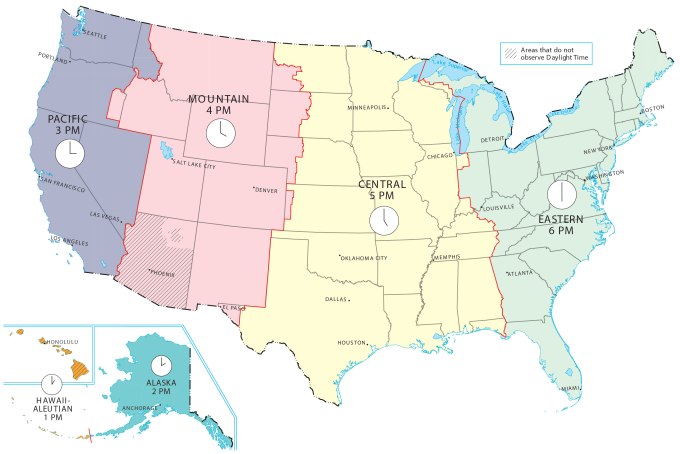
Those debates are background noise to me. I have no strong opinions about moving clocks back and forth each spring and fall. But the attention to daylight saving time always evokes another strong time-related emotion in me: A visceral annoyance about the westward creep of the Eastern time zone.

Source: https://gisgeography.com/us-time-zone-map/

I fully acknowledge that my feelings are irrational. No one cares what I think about this topic. Time zone boundaries are not an issue for most people. I cannot influence the situation or what people think about it. Nevertheless, I stew each fall and spring about the current unnatural Eastern time zone boundary. The current time zone map violates my sensibilities.

I was surprised this summer to see in a collection of stories by American humorist James Thurber that he had captured how I feel today in an Oct. 3, 1942, New Yorker article. Thurber described a gathering of journalists in a Columbus, Ohio, restaurant around 1920:

“We would sit around for an hour, drinking coffee, telling stories, drawing pictures on the tablecloth, and giving imitations of the most eminent Ohio political figures of the day, many of whom fanned their soup with their hats but had enough good, old-fashioned horse sense to realize that a proposal to shift clocks in the state from Central to Eastern standard time was directly contrary to the will of the Lord God Almighty and that the supporters of the project would burn in hell.”

The comment was funny in 1942 because Ohio had moved from Central to Eastern time in 1927. I agree, however, with the Ohio political figures Thurber described. That move “was directly contrary to the will of the Lord God Almighty.” Indiana extended the offense to my sensibilities in the 1960s. Indiana moved the Eastern time zone boundary to the middle of the state in 1961 and to the Illinois state line in 1969.

Except for six counties in the northwest corner and another six counties in the southwest corner, Indiana is now on the same time as New York and Washington, not Chicago, the traditional commercial center for the Midwestern agriculture market, of which Indiana is a part. That arrangement doesn’t make sense to me—especially when we consider when the sun rises and sets in Indiana.

Central time originally started much farther east

The Standard Time Act of 1918 originally drew a large Central time zone. The eastern side included portions of western New York and western Pennsylvania; all of Michigan, Ohio, Kentucky, and Tennessee; most of Georgia, and all of Florida.

Because of when the sun rises and sets throughout the year, I always thought that having all of Michigan, Ohio, Kentucky, and Tennessee in the Central time zone made sense. Central time coincided more closely with what I considered the natural range of daylight. Of course, policymakers disagreed. They saw some commercial advantage to having all or parts of these states on the same time as New York and Washington. Consequently, the time zone boundary crept west.

Today, the Central time zone boundary runs roughly along the Wisconsin and Illinois state lines (with carve-outs in northwest and southwest Indiana), through western Kentucky and east-central Tennessee, and down the Alabama state line toward the Gulf of Mexico. The Florida Panhandle is mostly in the Central time zone.

Between 1969 and 2006, Indiana compounded the time-zone confusion for me. Like Arizona and Hawaii, Indiana didn’t observe daylight saving time. Consequently, the state appeared to be in the Eastern time zone during the winter and the Central time zone during the summer. Eastern Standard Time is the same as Central Daylight Time from March through October.

October sunrises and sunsets in Indiana and eastern Kentucky are too late for me

In 2006, Indiana decided to observe daylight saving time. I experienced the results of that decision between 2008 and 2010 when my daughter attended graduate school at Indiana State University in Terre Haute. That city sits a few miles east of the Illinois state line. I visited Terre Haute regularly throughout those years. During October—just be for the “fall back” date—the sun would come up after 8 a.m.

My wife and I happened to be in Terre Haute in 2022 on the weekend of the fall time change. The experience annoyed me all over again. The sun rose at 8:21 a.m. and set at 6:45 p.m. EDT Nov. 5. The sun rose at 7:22 a.m. and set at 5:44 p.m. EST Nov. 6. Just a few miles west across the Wabash River in Illinois, the sun rose and set one hour earlier both days in Central time. The Central sunrise and sunset times were more in line, according to my sensibilities, “with the will of the Lord God Almighty” for the rhythm of a late fall day in that part of the world.

Indiana isn’t alone in its daylight irregularities. Kentucky has similar issues, in my opinion. When I was stationed at Fort Knox (1977-1981), I lived in Meade County and worked in Hardin County. Both were in Eastern time. Immediately to the west, Breckinridge and Grayson counties were in the Central time zone.

The original 1918 Central time zone line ran along the Kentucky-West Virginia state line—about 250 miles to the east. Consequently, much as I did in Terre Haute, I experienced many late fall sunrises and sunsets at Fort Knox. They bothered me.

Policymakers have adjusted boundaries for the Mountain and Pacific time zones since 1918, too. Because I have never lived in those time zones, I haven’t thought about the consequences of those changes. But the boundary shifts don’t look as drastic—or as unnatural—as the westward creep of the Eastern time zone.

I can’t shake these thoughts

I don’t know why I can’t get past my exasperation with expanding Eastern time. The emotion has persisted even though I have not lived or worked in Indiana or Kentucky since 1984. Driving trips between Texas and Virginia several times a year since 2010 rekindle my annoyance each time I encounter the time zone boundary farther west in Tennessee than I think is proper. The vexation intensifies at this time of year with each news story or reminder about the coming time change—even though those messages have nothing to do with the time zones. I, nonetheless, think of the folks in Terre Haute who must wait two hours longer than they should for the sun to come up.

In retirement, I have become an even grumpier old man than I was before.

Copyright © 2023 Douglas F. Cannon

Don’t miss Newspaper National Week

Heads up, everyone. National Newspaper Week runs Oct. 1 through 7. News Engagement Day is Oct. 3. International Newspaper Carrier Day is Oct. 7.

I suspect few people will notice these events. That lack of awareness is unfortunate. These three observances are supposed to call attention to how news organizations have served—and should continue to serve—local communities and American society.

Each October since 1940, the Newspaper Association Managers (NAM) has sponsored a weeklong promotion of the newspaper industry in the United States and Canada. The 2023 National Newspaper Week theme is “Print. Online. For You. #Newspapers Your Way.” NAM encourages publishers to run ads and write stories or editorials during the week to highlight the importance of newspapers to the communities they serve.

The Association for Education in Journalism and Mass Communication (AEJMC) launched News Engagement Day in October 2014. The day promotes a range of activities to encourage everyone—but especially high school and college students—to read, watch, like, tweet, post, listen to, or comment on news, and learn news reporting principles.

Paula Poindexter, the 2013-2014 AEJMC president, originally proposed the special day in Millennials, News, and Social Media: Is News Engagement a Thing of the Past? Poindexter, a pioneer in civic-duty-to-keep-informed research (see Sept. 9 post), wanted to counter the public’s declining attention to news, lack of understanding about journalism, and waning trust in the news media. She was convinced that declining news consumption was unhealthy for American democracy.

An adjunct to National Newspaper Week, International Newspaper Carrier Day salutes the many individuals who deliver the news to American homes and businesses each week. The News/Media Alliance produces ads to thank newspaper carriers during National Newspaper Week and on International Newspaper Carrier Day. Without news carriers, many people would not receive the news.

These events were important to me

When I was a newspaper carrier from 1964 to 1972 (The Herald, a neighborhood weekly in Columbus, Ohio; Upper Arlington News, a weekly in suburban Columbus; and the Columbus Citizen-Journal, a morning daily), I truly appreciated International Newspaper Carrier Day. Annual messages in each publication about the importance of newspaper carriers reinforced my belief that my delivery work was significant. I was part of the Fourth Estate, if in only a tiny way. I was helping keep people informed about the issues of the day.

Many people I served apparently were eager to get that information. On my Citizen-Journal route, people often met me at the door each morning to receive their copies and expressed their displeasure whenever I arrived after 6 a.m. Reading the newspaper was an important part of their daily routine. I would disrupt their schedule whenever I didn’t deliver on time.

All three newspapers I delivered, by the way, no longer exist.

As publisher of the weekly Sellersburg Star in Indiana from 1980 to 1982, I looked forward to National Newspaper Week each October. The special week gave me an excuse to write about the Star’s dedication to serving the West Clark County community; keeping readers informed about actions by the Sellersburg town government and West Clark Community School Corporation; and telling stories about residents of four communities: Borden, Henryville, Memphis, and Sellersburg.

Newspaper Week provided an opportunity as well to sell spots on a full-page cooperative ad about the value of newspapers to businesses that otherwise didn’t buy space in the Star. Businesspeople thought that newspapers in general were important but that advertising regularly in the Star wasn’t. “Everybody knows we’re here,” they used to tell me and my ad salespeople.

I had to close the Star in August 1982 during the economic recession at the time. Many long-established locally owned Sellersburg businesses closed during that time as well. While everybody may have known they were there, those establishments had trouble competing with chain stores in a regional mall just nine miles down the interstate highway that ran through town.

The newspaper business model has changed

The newspaper business today is nothing like what I experienced. The internet and social networks have disrupted the advertising-based business model I followed—especially for daily publications. Most “newspapers” today deliver information online as well as on paper. Daily publications now rely on subscribers, not advertising, for more than half their revenue.

But readership has slipped—especially for print editions. Pew Research reports that daily newspaper circulation of print editions in the United States fell from 63 million in the 1970s and 1980s to 24 million in 2020. Monthly visits to daily newspaper websites averaged slightly less than 14 million in 2020. Online readers, therefore, don’t make up for lost print readers. The decline in reach has limited what publishers can now charge for ads.

Most weeklies continue to generate much of their revenue—as I did at the Star—from local businesses that buy advertising space—on websites as well as on pages. But as happened in Sellersburg in the 1980s, current economic conditions have reduced what many businesses can spend on advertising.

Furthermore, other online channels can deliver information faster than print publications and offer cheaper, more targeted ways to advertise products and services. Free services like Craigslist have eliminated the demand for classified ads in many markets and removed a key revenue source for newspapers—especially community weeklies. Government officials in some states have worked to change laws that required government agencies to buy ad space in local newspapers for public notices, another once-reliable revenue source.

At the same time, operating costs—labor, production, printing, and distribution—continue to rise. Rising costs and declining revenues have squeezed publishers—especially those of small local newspapers—for years. Even those most dedicated to community service have had to cut back on the news they can provide.

Moreover, many readers have come to expect “news” to come free on their phones. Those folks don’t feel the need to pay for gathering that information. They don’t seem to realize that someone needs to seek out and report the news they see. Reporters don’t—and should not—work for free.

Many young adults have little-to-no experience with ink-on-paper newspapers, either. During my 13 years at Virginia Tech (2010 to 2023), I rarely found a student who reported looking at a printed publication for news. (I asked about news consumption in every undergraduate course.)

The odds of those reports changing are even more remote today. Forty-two of the nation’s largest 100 papers—which all once published multiple editions seven days a week—now produce a print edition six or fewer times a week, the 2022 State of Local News report from Northwestern University said. Eleven publish a print edition only once or twice a week and e-editions on other days.

Newspaper closures leave “news deserts”

Furthermore, the number of newspapers in the United States (both daily and weekly) has fallen from nearly 9,000 in 2004 to about 7,000 today. The 2022 report from Northwestern’s Medill School of Journalism, Media, Integrated Marketing Communication said that, on average, two newspapers close in the United States each week.

“Seventy million people live in the more than 200 counties without a newspaper, or in the 1,630 counties with only one paper—usually a weekly—covering multiple communities spread over a vast area,” the 2022 Northwestern report said.

Areas with no reporters regularly covering local happenings are called “news deserts.”

The 2022 State of Local News report said: “The loss of local journalism has been accompanied by the malignant spread of misinformation and disinformation, political polarization, eroding trust in media, and a yawning digital and economic divide among citizens. In communities without a credible source of local news, voter participation declines, corruption in both government and business increases, and local residents end up paying more in taxes and at checkout. This is a crisis for our democracy and our society.”

People miss local news

Often communities don’t realize how much they count on their local publication until it suspends operation.

In July, the Associated Press reported what happened in Welch, West Virginia, after its 100-year-old weekly newspaper closed:

“Residents suddenly have no way of knowing what’s going on at public meetings, which are not televised, nor are minutes or recordings posted online. Even basic tasks, like finding out about church happenings, have become challenging. The paper printed pages of religious events and directories every week and that hasn’t been replaced.

“Local crises, like the desperately needed upgrade of water and sewer systems, are going unreported. And there is no one to keep disinformation in check, like when the newspaper published a series of stories that dispelled the rumors of election tampering at local precincts during last year’s May primaries.”

Economically struggling and traditionally underserved communities have been the most likely to lose a news organization, the Northwestern report said. That loss of local reporting has exacerbated political, cultural, and economic divisions between and within communities. Residents need journalists to monitor local government and business activities.

Editor & Publisher, a newspaper trade publication, reported Sept. 25 that community leaders in Bedford County, Tennessee, quickly worked to replace their community newspaper when the 149-year-old Shelbyville Times-Gazette closed in July. Chris White, Bedford County’s director of planning; Greg Vick, District 2 county commissioner; and Curt Cobb, county clerk, talked about the value of local journalism and how it affected people and public policy.

With the encouragement of Bedford County leaders, Morristown, Tennessee-based Lakeway Publishers announced in early August that it would start two publications The Bedford County Post and The Marshall County Post — to cover Shelbyville and Lewisburg, Tennessee.

Industry faces challenge

How to get civic and business information to people in other communities that have lost local news operations is one major challenge facing the newspaper industry as we observe National Newspaper Week, News Engagement Day, and International News Carrier Day in 2023.

Recent legislative, philanthropic, university, and industry initiatives have identified a range of options. According to the 2022 Northwestern report, they include public funding of local news, joint reporting ventures by local news operations, and new nonprofit and hybrid business models.

Communication theorist Marshall McLuhan once said, “People don’t actually read newspapers. They step into them every morning like a hot bath.” I doubt that many news consumers today experience the alerts they receive on their phones the same way. But as the 2023 National Newspaper Week theme indicates, many people can now get news the way they want.

Let’s hope the industry finds a way to broaden its reach—especially for local news—and regain the relevance it had when I worked in newspapers 40 years ago. If it doesn’t, the 2022 Northwestern report said, local news may be available only in affluent and growing communities, where residents can afford to pay for it. We need to avoid that outcome.

Copyright © 2023 Douglas F. Cannon

More teens than we thought might see news each day

More young Americans than we thought might be reading news reports each day. Furthermore, minor changes in social network features could influence how consumers of all ages process the information they see.

Still, we’ll need more evidence—especially about why young people look at the news—before we can determine if any of these communication dynamics affect belief in the civic duty to keep informed (see Sept. 4 post).

Teen news engagement

Research from Northwestern University, announced Sept. 6, reported that 29% of U.S. teens said they saw news reports daily. The percentage climbed into the 40s for weekly news engagement.

“Older teens (16 to 17 years old) showed slightly higher engagement levels than younger teens (13 to 15 years old),” said a news release from Northwestern’s Medill School of Journalism, Media, Integrated Marketing Communications. “This finding may seem logical given that the college application process and eligibility to vote may trigger increased interest in national events.”

The reference to voting got my attention. Past communication research has shown that voting-age adults felt obligated to keep up with current affairs. Citizens said they needed to know what was happening so they could be informed voters (civic duty to keep informed).

The Northwestern survey didn’t appear to ask teens way they looked at news items daily or weekly. Therefore, we can’t tell if they were motivated by a similar civic duty to keep informed.

Nevertheless, the Northwestern news engagement results for young Americans appeared more optimistic than what we saw in the June 2023 Digital News Report from the Reuters Institute at Oxford University (see Sept. 4 post). That study said that only 49% of Americans overall were interested in news. “Self-declared interest in news is lower amongst women and younger people, with the falls often greatest in countries characterised by high levels of political polarization,” the report said (p. 21).

“The (Northwestern) survey found more engagement with news among teens than we were expecting,” said Stephanie Edgerly, associate dean for research at Northwestern’s Medill School, in the online news release. “We found that 29% of teens said they encounter news daily. That’s encouraging.”

The Northwestern research reported that 46% of teens saw local TV news daily or weekly and that 42% encountered national network TV news daily or weekly. About a third of the teens surveyed said they engaged with news on YouTube (37%), TikTok (35%), or Instagram (33%) daily or weekly, although the sources of that news were not known.

Only 5% of teens said they encountered news daily through local or national newspapers. The numbers were higher for weekly news encounters in local newspapers (18%) and national newspapers (13%).

Classroom assignments may have contributed to teen news engagement. Three-quarters (75%) of the teens surveyed said they discussed news stories in school classes, and 62% followed the news as part of a class assignment. Another 59% said they discussed how to tell whether information could be trusted.

“This survey provides a snapshot of how U.S. teens are engaging with news, and we don’t often get data this level of detail from a large national sample of U.S. teens,” Edgerly said in the online release. “It’s great in helping clarify trends.”

Social media dynamics

Because more than one-third of teens encountered news through online social networks, I noted two additional studies, reported Sept. 11 by Newman Lab. These two studies indicated that seemingly simple changes to social media features could affect user opinions and news dissemination. Such factors, therefore, might play some role in teen news engagement as well.

One study showed that online endorsements, such as likes and retweets, influenced people’s opinions of policies related to COVID-19. Participants in an experiment saw two versions of a social media post about tensions between economic activity and public health. Those who viewed pro-economy posts with a high number of likes were less likely to favor pandemic-related restrictions, such as banning gatherings. Those who viewed pro-public health posts with a high number of likes were more likely to favor restrictions. The experiment involved participants from the United States, Italy, and Ireland.

The other study examined how a change to Twitter’s retweet policy a few weeks before the 2020 presidential election affected news dissemination. The change encouraged users to add their own commentary when they retweeted information. Twitter hoped the change would prompt users to reflect on the content they were sharing and slow the spread of misinformation.

The result, according to the study, was a drop in retweets on average across several U.S. news outlets by more than 15%. The average drop in retweets for “liberal” outlets was more than 20%, but the drop for “conservative” outlets was only 5%. Furthermore, the Twitter policy appeared to affect visits to news websites. That change suggested that the new policy had influenced news dissemination overall.

Instagram, Threads, and X (formerly Twitter) now allow some users to hide the number of likes on posts, the Newman Lab item said. As a result, author Juan S. Morales, assistant professor of economics at Wilfrid Laurier University, speculated those changes could affect political discourse on social networks.

No information on teen motivations

The idea that more young Americans than we expected are regularly seeing news reports is encouraging. I’m glad to see that schools are requiring teens to read news stories and are helping students judge the credibility of reports. I’m intrigued by how characteristics of the social media environment can affect the way people process information they see.

We still don’t know, however, why teens engage with news—other than to complete class assignments. Consequently, we can’t determine whether young people today recognize the same civic duty to keep informed that earlier generations reported. We may not be able to assume, therefore, the same connections between news consumption, public opinion formation, and voting behavior that we once did.

The relationship between news engagement, public opinion, and electoral behavior remains a fertile field for research—especially in today’s vibrant communication landscape and polarized political environment.

Copyright © 2023 Douglas F. Cannon

Declining belief in the “civil duty to keep informed”

Recent research indicates that belief among Americans in the civic duty to keep informed continues to fade.

Mass communication research from 1982 to 2000 analyzed the civic duty to keep informed among Americans. Studies consistently showed that voting-age adults felt obligated to keep up with current affairs. Citizens said they needed to know what was happening so they could be informed voters. Highly educated people usually felt a stronger duty to stay informed than those with lower education levels. Adults sought out civic information from print, broadcast, and online news organizations.

The 2023 results from the Reuters Institute for the Study of Journalism show much less interest among Americans in keeping up with the news than earlier researchers identified. The 2023 results support findings from a 2014 study I did among Virginia Tech students. That limited analysis, published in 2017 in the Newspaper Research Journal, determined that millennials didn’t recognize a duty to keep up with political news the way earlier generations did. The young people born at the end of the 20th century indicated no clear commitment to keeping up with civic or political events—even though more than half the people in my survey said they saw news reports at least six days a week.

Interest in news drops

The 12th edition of the Digital News Report, released in June by the Reuters Institute at Oxford University, showed that only 49% of Americans in 2023 said they were interested in news. That percentage was 18 points lower than in 2015, the year after my study.

Reuters researchers found that 12% of Americans in 2023 said they had not looked at any news reports in the past week. That news engagement level was much lower than I identified in my research. Reuters said interest in news in 2023 was lowest among women and young people.

“In the United States, we find that consumers are more likely to avoid subjects such as national politics and social justice, where debates over issues such as gender, sexuality, and race have become highly politicised,” the Reuters study said.

An Aug. 1 Washington Post article about the Reuters findings used Claudia Caplin to illustrate the change in news consumption. The retired advertising executive used to read two newspapers each morning, watch television news in the afternoon or evening, and listen to NPR programs during trips in her car.

During the COVID-19 pandemic, however, she began to consume less news, the Post story said. She reportedly found news coverage too “apocalyptic.”

“I’ve always felt I had a responsibility to know everything,” she told the Post. “I don’t feel that way anymore.”

Caplin’s quotation summarizes the apparent change in the civic duty to keep informed.

Reasons for the change unclear

I don’t know—and neither do other researchers—exactly why people no longer feel obligated to stay informed. The 2023 Reuters report, which gathered data from six continents and 46 markets, identified several possible factors:

  • Relying on social networks rather than traditional news organizations for information.
  • Low trust in an ever-expanding array of online information sources.
  • Lack of interest in what many news sources report.
  • Rising costs for news content reported by working journalists.

“When it comes to news,” the Reuters report said, “audiences say they pay more attention to celebrities, influencers, and social media personalities than journalists in networks like TikTok, Instagram, and Snapchat. This contrasts sharply with Facebook and Twitter, where news media and journalists are still central to the conversation.”

Many people were skeptical of algorithms used to select what they saw via search engines, social networks, and other platforms, the Reuters report said. Nevertheless, users still slightly preferred news selected by algorithms to content chosen by editors.

Another factor, according to Rasmus Kleis Nielsen, the Reuters Institute’s director (quoted in the Post story), could be that publishers focus on consumers willing to pay for news content. Consequently, news organizations report stories intended to attract “politically interested” readers. That focus drives away politically disconnected individuals.

Assumptions questioned

Two assumptions of civic-duty research were that citizens with a strong sense of civic duty to keep informed would (1) seek out information from news media about issues facing the government and (2) be more likely to vote than those who do not accept such a duty.

With fewer people today interested in news reports, the first assumption may no longer be valid. I’ve already questioned whether—as the Libertarian press theory maintains—we can count on news consumers to seek out information on all sides of a topic (see July 21 post about press theories).

The second assumption may be debatable as well. Public opinion polls and academic research on voter participation often offer contradictory information.

Some reports say issues, such as abortion, drive increased voter participation—especially among women and young voters. Gallup reported July 23 that women and men hold similar views on the legality of abortion at each stage of pregnancy. Overall, Gallup reported that a record-high 69% of Americans said abortion should generally be legal in the first three months of pregnancy and that 34% said abortion should be legal in all cases.

Pew Research reported July 12 that women voted more for Republican candidates than Democrats in the 2020 and 2022 elections. GOP candidates tend to oppose access to abortions.

Pew reported that voters 50 and older accounted for a larger share of the total electorate in 2022 (64%) than in the past three elections. The share of voters 18 to 29 went from 11% in 2018 to 14% in 2020 and 10% in 2022.

Other sources said that multiple factors—income, racial segregation, education level, political polarization, and the work of nonprofits—determined civic and political engagement among young people. In communities where young adults volunteered, helped their neighbors, and belonged to groups or associations, people in that age group voted.

Thinking may need to change

The 2023 Reuters results raise a crucial question about potential voters today: How can the 51% of Americans not interested in news find credible information to inform their choices at the ballot box?

Traditional democratic theory—what I learned during high school civics in the late 1960s—lists variables that increase citizen engagement in democratic systems. Freedom of information about government functions and openness by public officials about their plans were influential factors. Political candidates who avoided public scrutiny could mislead uninformed voters.

If Americans today don’t see their role as news consumers the way that people in my generation were taught to expect, we may need to adjust our thinking about how news consumption influences voting.

Copyright © 2023 Douglas F. Cannon

A radical opinion about political discourse?

Seven recent news stories illustrate—for me at least—that shorthand political labels don’t clearly communicate where people fall on today’s ideological spectrum. “Liberal,” “moderate,” and “conservative” have lost any clear meaning for me. I think such labels contribute more to misunderstanding than to precise communication.

“Generally,” The Associated Press Stylebook says, “a description of specific political views is more informative than a generic label like liberal or conservative.”

I concur. I advise writers I work with to avoid shorthand labels and to explain clearly the political or social position they are reporting.

I acknowledge at the outset of this long post that many people don’t agree with my opinions about shorthand political labels. Family members, colleagues, and students have regularly told me over the years that I’m wrong or too picky about the use of political labels. They say everyone knows what a “liberal,” “moderate,” or “conservative” is. I disagree. Things that were once part of the conservative agenda, for example, such as limiting the size of government, supporting free trade, and controlling the national debt, are not current priorities among so-called “conservatives.” The seven examples below should illustrate my thinking further.

When I started this essay, I intended to advocate what I thought would be a conservative position. I would echo AP Stylebook guidance about avoiding shorthand labels. Reactions to my ideas over the past week have changed my mind. My thinking appears to be either radical or reactionary.

Nevertheless, I’m content to share my thoughts on this communication challenge. The fun of these essays is trying to explain my viewpoint. I don’t need to convince anyone that I’m right.

Consider the ambiguity that shorthand labels introduce in these examples:

Pope Francis and critics in the American church

Pope Francis communicated accurately in early August what he thought of some American Roman Catholics. He criticized “a very strong, organized reactionary attitude” among some American church members. He acknowledged that “backward-looking people” in the U.S. church opposed his leadership on current moral questions and wanted to reverse reforms brought about by the Second Vatican Council, which met from 1962 to 1965.

American journalists muddled the pope’s message. The Associated Press reported Aug. 28 that Francis had “blasted the ‘backwardness’ of some conservatives in the U.S. Catholic Church.” The Washington Post’s online headline for its Aug. 29 story said, “Pope Francis criticizes ‘reactionary’ conservatives in U.S. Catholic Church.” The New York Times said in its Aug 30 story, “The pope lamented the ‘backwardness’ of some American conservatives who he said insist on a narrow, outdated and unchanging vision.”

The use of conservatives in these three stories doesn’t match my understanding of the word. “Conservatives,” Merriam-Webster’s online dictionary says, want to maintain existing views, conditions, or institutions.

The Second Vatican Council ended in 1965. Its reforms have been in effect for nearly 60 years—longer than most American Roman Catholics have been alive. Pew Research said in 2015 that the median age of U.S. Roman Catholics was 49. The post-Vatican II church is the only one most American worshippers have ever known. Post-Vatican II doctrines, therefore, are the current tradition. The church members whom Francis criticized are, therefore, not conservatives. True conservatives would want to maintain the post-Vatican II doctrines.

The people opposing Francis are reactionary, just as the pope said. They want to go back to the way things in the church were before the Second Vatican Council.

Calling critics of the pope conservative is inaccurate. “Reactionary conservative” is an oxymoron. If you want to keep what the church is doing now (the conservative stance), you wouldn’t want to go back to what the church used to do (the reactionary stance).

Plan to transform the federal government in a second Trump administration.

The Associated Press reported Aug. 29 on a “constellation of conservative organizations” that want “to gut the ‘administrative state’ (federal bureaucracy) from within” if Donald Trump is reelected president. The group’s plan calls for “ousting federal employees they believe are standing in the way of the president’s agenda and replacing them with like-minded officials more eager to fulfill a new executive’s approach to governing.”

The Aug. 29 story says the plan contains “a mix of longstanding conservative policies and stark, head-turning proposals that gained prominence in the Trump era.” The plan was written by “some of today’s most prominent thinkers in the conservative movement.”

“A new executive approach to governing” doesn’t sound very conservative to me. “Stark, head-turning proposals” would appear to describe something radical.

Views on abortion in Door County, Wisconsin

A Sept. 2 Washington Post story examined how the “Abortion fight unites the left and rattles the right in key Wis. Battleground.” That story used “conservative” and “the right” as synonyms for “Republican.” “Liberal” and “the left” meant “Democrat.” Nevertheless, the facts in the story demonstrated that these liberal and conservative labels were too general to accurately categorize Republican or Democratic voters in Door County, Wisconsin.

“We’ve got disagreements on this (abortion) issue within our own party,” the story quoted one Republican leader as saying. “That’s the challenge: Finding a message we can all agree on.”

Corporate ‘liberalism’ in politics today

A Sept. 3 Washington Post opinion piece said corporate “liberalism” was changing today’s political landscape. The commentary reported results of an academic study of 320 business elites and 670 “ordinary people.” That study found that both Democratic and Republican business elites thought corporate America was moving away from a close connection to the Republican Party.

The commentary equated “the decoupling of business from the Republican coalition” with businesses becoming more “liberal.”— “that is, more deferential to authority and more favorably disposed to bureaucracy and expertise.”

“Conservatism, meanwhile,” the story said, “has moved in the opposite direction and become more populist and mistrustful of institutions.”

I noted that no quotations in the commentary from the research paper itself mentioned “liberal” or “conservative.” The opinion writer introduced those labels. The research analyzed a new way of thinking among Republican and Democratic business elites. The study, therefore, didn’t consider whether executives were liberal or conservative. The research examined the partisan identification of businesspeople with various ideas about how to interact with government. The opinion writer decided that “Democrat” equaled “liberal” and “Republican” equaled “conservative.”

Shifting stereotypes

The seven examples I’ve cited illustrate how empty common political labels have become, as far as I’m concerned. Labels reflect stereotypes. In these seven examples, however, the stereotypes are no longer accurate. The Sept. 3 Washington Post commentary shows that the business community’s political alignment is changing and that Republicans are becoming more populist. Language evolution has not kept pace with such political trends. As a result, American journalists (and others) no longer have a precise shorthand for the shifting social/political spectrum.

Labels like “liberal” or “conservative”—for me at least—are supposed to describe how a person or a movement approaches social or political change. These labels are not tied to specific sets of policies or specific political parties.

Conservatives, in my understanding, aren’t eager to change. They want to maintain (or conserve) the systems and traditions we have now. Moderates accept measured change. Moderates don’t like extreme actions. Liberals are open to more extensive change than moderates and don’t feel tied to traditional ways of approaching things the way conservatives do. Radicals favor throwing out traditions and trying things that have never been done before. Reactionaries want to go back to the way things used to be.

Not a left-right political axis

A further complication to clear communication is that many people—both writers and readers—conceive of our political spectrum today as a horizontal right-left axis. Conservative and liberal are at opposite ends of that horizontal line. Moderate is in the middle.

The political spectrum is really a circle with at least five reference points: reactionary, conservative, moderate, liberal, and radical. Where a person or issue lands on that circle depends on place and time. The left-right axis eliminates the extremes (reactionary and radical) from our routine political lexicon and, as we saw in the Pope Francis story, limits how people can discuss approaches to social or political change beyond the axis.

Policies vs. approach to change

Because social and political context determines where an issue lands in the political spectrum, viewpoints could be liberal at one point, conservative at another, and reactionary or radical in yet another context.

For many Americans today, for example, traditional conservative policies favor limited government, low taxation, fiscal responsibility, free market capitalism, capital punishment, immigration controls, integrity of elections, and a strong national defense. Traditional conservative policies oppose gun control, abortion, same-sex marriage, affirmative action, government-funded healthcare, and expanded benefits for social welfare programs.

Traditional liberal policies favor government actions to defend individual rights (affirmative action, same-sex marriage, abortion), ensure social equality among all citizens through government-funded benefits, facilitate broad participation in elections, promote equitable tax burdens for all, control access to guns, and protect the environment.

Neither of these issue agendas considers how an advocate approaches change. Some of these policies are in place today. Others are not. Still others were once in place but are no longer.

Therefore, if a person is trying to maintain what we have, I argue that he or she is a conservative. Actions to change what we have could be reactionary, moderate, liberal, or radical. The direction or degree of change determines the shorthand label. Moves to go back to something we had before would be reactionary. Moves toward something completely new would be radical. Small, measured changes would be moderate. Major changes would be liberal.

I know as well that the Republican and Democratic party positions on many political issues have shifted throughout American history. Republican-backed policies were not always conservative. Democratic stands were not always liberal.

After the Civil War, for example, one wing of the Republican Party was called radical for its approach to southern Reconstruction. President Theodore Roosevelt, Governor Thomas E. Dewey, and Vice President Nelson Rockefeller—all New Yorkers—represented the liberal wing of the Republican Party between 1900 and 1972.

Republican policies on such topics as immigration and free trade after the Trump presidency differ significantly from what Republicans supported under Presidents Ronald Reagan, George H. W. Bush, and George W. Bush. Nevertheless, many Americans identify all those presidents as conservative.

Democrats before the 1960s were often seen—especially in the South—as the nation’s conservative party. Today’s Democratic Party includes U.S. Sen. Joe Manchin, D-W.Va.; U.S. Rep. Henry Cuellar, D-Texas; U.S. Rep. Alexandria Ocasio-Cortez, D-N.Y.; and U.S. Ilhan Omar, D-Minn.

Manchin and Cuellar are often called conservative because they frequently agree with Republicans on policy. Ocasio-Cortez and Omar are prominent members of “the Squad,” a group of young lawmakers who favor what I would term radical policies. Those include Medicare for All, the Green New Deal, and total student loan forgiveness. We haven’t had policies like those before.

Self-identities

Self-identities are another factor in how people understand political shorthand labels.

I’ve noticed that people who consider themselves conservative or moderate have no problem embracing those labels. Those individuals usually align their identities with their political party affiliations or opinions on social issues, such as taxation, immigration, voting rights, public education, gun control, or free speech. To those folks, conservative or moderate usually doesn’t relate to the way they approach change.

Those who favor significant social or political change may equate their identities as well with how the person stands on certain issues. But these individuals often don’t want to be called liberal, radical, or reactionary. Persistent Republican messaging since at least the 1990s has made liberal a pejorative term. Radical and reactionary have long had negative connotations. Consequently, folks who advocate significant change call themselves “progressive.”

While liberals, moderates, and conservatives may identify with specific political agendas, each person’s orientation to change may not be consistent from issue to issue or across party lines. Voter opinions on various issues are dynamic and often erratic. As in the Sept. 2 story about Door County, Wisconsin, one shorthand label may not correctly describe where someone stands on all issues.

Between the 1973 U.S. Supreme Court decision in Roe vs. Wade and the 2022 decision in Dobbs vs. Jackson, for example, access to abortion was legal and the accepted norm. Efforts to defend abortion rights in that context, therefore, were conservative (maintaining what we have). Efforts to overturn the Roe decision and return to the former standards were reactionary (going back to the way things used to be).

After the Dobbs decisions, efforts to defend abortion bans are conservative (maintaining the new standard). Efforts to return to the Roe standards are reactionary (going back to the way things used to be). Efforts to go beyond restrictions that were in place before 1973 or to introduce new ways to enforce abortion bans are radical (trying things that have never been done before).

The Washington Post story about Door County, Wisconsin, however, used the longstanding shorthand labels traditionally applied to the abortion debate: Those who oppose the Dobbs decision are liberal or left-learning, not reactionary. Those who want to tighten abortion restrictions beyond pre-Roe standards are conservative, not radical.

I find those traditional labels misleading. I know people disagree with me.

Heated reactions

My pointing out differences between people’s approaches to change and the way they label their political agendas often elicits heated reactions.

My “liberal” friends take offense when I suggest that their defense of current federal or state social programs is conservative and that their efforts to ban assault rifles are reactionary. Current programs are the norm. The United States had an assault weapons ban from 1994 to 2004.

My “conservative” friends often get hostile when I say that attacks on civil liberties, efforts to militarize our borders, or moves to eliminate birthright citizenship under the 14th Amendment to the U.S. Constitution (ratified in 1868) are radical, not conservative, positions. We haven’t tried these policies before. I get similar responses when I contend that moves to protect election integrity and restrict voter participation could be seen as reactionary. States routinely limited minority access to the ballot box before a series of federal civil rights acts passed from 1957 to 1968.

Because of these unreceptive reactions to my opinions, I’ve reconsidered whether understanding that a political position is radical or reactionary, rather than liberal or conservative, improves political discourse in the long run. The situation may be like the communication problem of using plural pronouns to stand for singular nouns (see Aug. 19 post). Consequently, I don’t bring these topics up much anymore in face-to-face meetings (see spiral of silence theory).

I still think about philosophical inconsistencies, however—especially when I see stories like the seven I’ve cited here. Those thoughts make this post appropriate for this blog.

Overly general?

The Associate Press Stylebook advises journalists to “think carefully” before using shorthand descriptions. Reporters and editors should “consider whether any broad term such as gays, liberals, conservatives, Americans (or any nationality), Latinos (or any ethnicity), supporters of Candidate X, etc., is overly general.”

We all use shorthand descriptions as a communication crutch. These labels help organize our world into categories and supposedly help simplify messaging. But when labels are ambiguous, they may not only hurt clear communication. They may also add to the growing partisan divide in American society today.

Labels help people separate themselves from others. This sorting may encourage folks to avoid interactions with others who have differing opinions. People isolated from diverse viewpoints often see mostly how their opinions differ from those of folks in other groups, not where everyone shares common ground.

While ongoing dialog between people who don’t agree might not change minds, these exchanges should help deepen understanding of contrary viewpoints and counter continued political polarization. Demonizing someone you know is harder than fostering enmity toward nameless, faceless “liberals” or “conservatives”—no matter what you think those words mean.

Copyright © 2023 Douglas F. Cannon
Rebuilding trust vs. changing reputation

The Centers for Disease Control and Prevention has a reputation problem, according to its new director. So do many universities, according to an Aug. 17 PR News story.

But neither the CDC director nor various university public relations advisers are talking about reputation. Comments in news stories focus on rebuilding trust. While trust is one product of reputation, a narrow focus on trust could limit how organizations try to solve their business problems. In fact, decision-makers focused on trust might overlook a key element of reputation: authenticity.

John Doorley, executive director of corporate communications at Merk & Company from 1987 to 2000 and later a communication professor at Rutgers, New York University, and Elon University, developed a reputation management formula in 2003:

Reputation = Performance + Behavior + Communication x Authenticity Factory

“Performance” represents financial returns (profits and losses) and the delivery of quality products or services. “Behavior” means organizational interactions with key groups, such as employees, customers, regulators, critics, and local neighbors. “Communication” covers messages sent through all channels to all groups.

The Authenticity Factor indicates how true all actions and messages are to an organization’s “intrinsic identity” (what it stands for). If an organization stays true to what it stands for, the Authenticity Factor is 1. Any action or message that is not authentic reduces the factor and lowers the sum of images derived from Performance, Behavior, and Communication.

Doorley explains the formula in Reputation Management: The Key to Successful Public Relations and Corporate Communication. He and Fred Garcia first published that book in 2006. It is now in its fourth edition (2021).

Trust reflects people’s confidence that individuals and organizations will do what they promise. Just as trustworthiness is one facet of reputation, so are credibility, reliability, and responsibility.

Dr. Mandy Cohen, the new CDC director, has said in recent news interviews and public statements that she wants to rebuild trust in the CDC, other government institutions, and the scientific process. Even though Cohen hasn’t mentioned reputation, she appears to recognize that CDC efforts must address elements in the reputation formula. She told NBC News July 20 that her “intentional plan” to rebuild trust in the CDC involved “good execution” of the CDC public health mission, transparency, and good communication.

Cohen again talked about good performance, transparency, and clear communication Aug. 1 on NPR’s All Things Considered. She added a fourth component to her plan: partnerships and relationships with various groups. “And we’re going to be focused on building those bridges and building that trust so that folks take vaccines,” Cohen said.

Cohen’s strategy covers three elements of the Doorley formula:

  • Performance—“making sure that we are doing what we say we’re going to do.” That performance should enhance trust as well.
  • Behavior—transparency in interactions with critics, members of Congress, and others.
  • Communication—delivering clear, simple messages that all segments of the public can understand.

But the director does not appear to have thought about the Authenticity Factor (the perception that all actions and messages are consistent with what Americans would expect from the nation’s top public health agency).

The Aug. 17 PR News story shows the same shortsightedness about reputation—this time related to universities in the wake of a June U.S. Supreme Court decision on affirmative-action standards in college admissions. That story asserts, “The schools will need to rebuild trust for not only potential students and their families, but alumni, employees and staff of the institutions.”

The story quotes three sources. Two of them, a public relations practitioner and a public relations educator, both said that universities should act transparently and send clear messages about future admissions policies to key publics to rebuild trust. The third, another practitioner, said that admissions policies needed to reflect core institutional values.

With these comments, the PR News story alluded to Performance, Behavior, and Communication by university administrators. But none of the sources talked about the need to be authentic.

The difference between “building trust” and strategically trying to shape an organization’s overall reputation isn’t just semantic. I’m sure some will accuse me of fussing too much about the distinction. But word choice frequently reflects the scope of a person’s or organization’s thinking.

Too many public relations practitioners—and CEOs, for that matter—avoid talking about reputation. One reason may be that reputation is intangible and supposedly hard to measure. Consequently, both business leaders and public relations practitioners often use measures of trust as proxies for measures of reputation. The annual Edelman Trust Barometer is an example of such a proxy measure.

From my perspective, the focus on trust isn’t enough. The Authenticity Factor can make or break an effort to change the way people think about an organization—especially in a polarized public opinion environment. Any strategy that leaves out the last part of the Doorley formula can’t effectively build trust or change reputation.

Determining what people in various constituencies would consider authentic is often a challenge. For example, critics during the COVID-19 pandemic effectively demonized the CDC’s traditional data-driven approach to public health policy. Simply doubling down on that approach—which Cohen seems to imply (“have good performance in what the CDC is meant to do”)—isn’t likely to be effective. Polls repeatedly show that many Americans have lost trust in medical scientists since the pandemic.

Similarly, universities—especially those named in the affirmative-action lawsuit (Harvard University and the University of North Carolina at Chapel Hill)—have had a hard time countering charges that they have unfairly used race to decide which students to admit.

Both the CDC and universities need to know what key constituents are willing to believe. Critics have controlled the public health and higher education narrative for the past few years. Changing current opinions among people in some groups, therefore, may be a genuine challenge.

The partnership aspect of Cohen’s strategy could help with authenticity in the CDC effort, but she didn’t provide enough details in the two news interviews for me to speculate further.

The PR News story appears to imply that making sure constituents understand the values driving university admissions decisions will help make actions appear authentic. But what if the people universities need to reach don’t share those values?

I hope public relations staffers at the CDC and various universities are wise enough and influential enough within their organizations to help their bosses reach their real management goal: a better organizational reputation. Broadening that vision beyond “building trust” might help. But supplying solid intelligence on what key constituencies would see as authentic would be even more important.

Unfortunately, I know from 28 years in Army public affairs that government public relations efforts often lack adequate research on key groups. We in the government know what we want to say, but we don’t know what people in those groups are willing to hear or believe.

University communication offices may have more information on their key publics, but I don’t know that for sure. I suspect that access to research on key publics varies from institution to institution.

I commend Cohen’s intentions. I wish the CDC and various universities success in their efforts to change their public image. In the process, I hope that organizational leaders come to recognize the importance of authenticity in shaping reputation as they promote excellent performance, transparent behaviors, and clear communication.

Copyright © 2023 Douglas F. Cannon

In support of neopronouns

Pronoun ambiguity—especially the use of the singular “they,” “them,” or “their” in broadcast news reports—continues to introduce what I consider unfortunate barriers to clear communication. I have written about pronouns before. (See Aug. 31, 2015, post.)

English writers and speakers need gender-neutral neopronouns. Those new words could solve lots of comprehension problems. I recognize that such word-use evolution is unlikely.

Nevertheless, a gender-neutral third-person singular pronoun could enhance clear communication and avoid the confusion I experienced with an Aug. 15 NPR story on Morning Edition. That story included these sentences:

“Pagonis is intersex but was never told this by their parents. Growing up they felt like they didn’t belong.”

Because I (1) was doing something else as I listened to Morning Edition in the background and (2) have been drilled throughout my schooling and career to think that pronouns are supposed to agree with the first noun of the same number and gender before the pronoun, I at first understood the broadcast story to say that the parents had felt excluded when they were growing up. As I began to listen to the story more closely, I thought it would tell me how that viewpoint had affected the way the parents had dealt with their intersex child.

In a few more seconds, I realized I was wrong. Pidgeon Pagonis, the subject of the story, used plural pronouns for self-reference. Consequently, so did the reporter conducting the interview.

I don’t object to the use of preferred pronouns. I don’t advocate that we violate anyone’s self-identity. The latest edition of the Publication Manual of the American Psychological Association says in Section 4.18: “The use of the singular ‘they’ is inclusive of all people, helps writers avoid making assumptions about gender, and is part of APA style.” I know that the singular “they” has become more common in academic writing since my 2015 post.

My issue in this instance is miscommunication—especially in broadcast writing. I contend that the broadcast writer should have recognized the possibility of listener confusion in this story and worked intentionally to avoid it.

The clear connection between a pronoun and its antecedent is especially important in broadcast writing. Listeners and viewers can’t go back to check the reference. Consequently, the singular “they” in broadcast newswriting can hinder listening comprehension.

The Association Press Stylebook (56th edition) makes a similar point about reading news stories. The stylebook notes on Pages 238 and 239: “They as a singular pronoun may be confusing to some readers and amount to a roadblock that stops them from reading further. At the same time, though, efforts to write without pronouns to avoid confusion may make people feel censored or invisible.”

The AP stylebook advises journalists to honor story subjects and readers by striving for clarity. Often, rewriting a sentence can achieve that goal.

I concur. That quest for clarity is even more important in broadcast writing. The message recipient has no easy way to review the text when something doesn’t make sense on the first hearing.

Another way to address pronoun ambiguity might be to adopt neopronouns. I, therefore, appreciated the Aug. 12 CNN story about these “new pronouns.” Words, such as xe/xyr or ey/em/eir, are gender-neutral. They could follow standard grammar rules and avoid the conceptual problem of referring to a singular entity as a plural.

Despite being called “new,” some of these pronouns were first used in English hundreds of years ago. However, most people have not encountered such words in their reading or listening.

Deciding which new third-person neopronoun to use would be a challenge. The CNN story lists at least four options. None of those options looks like any common English words. As a result, The Associated Press Stylebook says, “In general, do not use neopronouns such as xe or zim; they are rarely used and unrecognizable as words to general audiences.”

Getting people to make one of those pronouns the standard would take a long time. The New York Times reported that “Ms.,” the inclusive alternative to “Miss” or Mrs.,” was first suggested in 1901. While the honorific has become more common since the 1960s, some people still refuse to use it.

Latinx,” an inclusive alternative to “Latino” or “Latina,” reportedly first appeared in 2004. While “Latinx” is popular in some business and academic circles, a 2020 Pew Research survey found that only 3% of Americans with ethnic backgrounds from Latin America or Spain used the word to describe themselves.

People can tell intuitively what “Ms.” and “Latinx” are trying to communicate—even if those same individuals would not choose to use those words. Neopronouns don’t have that intuitive quality. Therefore, broad adoption—if it were ever to happen—would probably take even more time than “Ms.” or “Latinx” has needed so far to gain just some recognition.

While I know that the adoption of neopronouns is unlikely, I still think we need a better alternative for inclusive third-person pronouns than the singular “they.” As long as most writers and speakers are satisfied with the ambiguity of using a plural word to stand for a singular noun, we’ll have to live with persistent possible miscommunication. Or we’ll have to wait for all the old geezers like me—who think that using a plural word for a singular meaning is a problem—to die off.

Copyright © 2023 Douglas F. Cannon

Need for SPJ conduct code is troubling

The Aug. 12 email message from the Society of Professional Journalists surprised me. “SPJ needs feedback on Code of Conduct draft,” the subject line said.

The message invited me to register for an Aug. 14 online meeting “to discuss the working copy” of a Code of Conduct for SPJ events. I could submit questions or comments about the code by Aug. 13 through the SPJ website.

Wow, I thought. This situation is troubling. Why would an organization of print, online, and broadcast reporters and editors; journalism educators; news executives; and other news content creators need formal rules to govern interpersonal interactions at meetings? What have I missed?

The email message said the SPJ board of directors wanted “to foster a friendly, safe and welcoming culture.” A special task force “plans to have standards for expected behavior in place by the annual convention in Las Vegas on Sept. 28.”

The working SPJ conduct code specifically addresses “behavior that others would reasonably perceive as knowingly harassing or humiliating others” at “events and meetings sponsored by or affiliated with SPJ at the national and regional levels.” The proposed SPJ guidelines further prohibit “discriminatory conduct related to age, race, ethnicity, gender identity or expression, sexual orientation, physical ability or appearance, religion, or political ideology.”

The conduct code covers all who attend SPJ events. “Violators can be immediately dismissed from events, excluded from in-person or online events and activities, and/or forfeit their SPJ membership,” the draft document says. The document proposes a procedure to warn, suspend, or expel members who violate code provisions.

A Google search yielded no background information on why SPJ might need such behavior rules now. I couldn’t determine if the proposed policies were proactive or reactive.

The SPJ website, where I could submit comments, included links to nine example codes of conduct from other journalism professional organizations. One link showed that SPJ had instituted a code of conduct for its 2019 joint Excellence in Journalism meeting with the Radio Television Digital News Association and National Association of Hispanic Journalists in San Antonio.

Clearly, the idea of conduct rules for meetings of journalists isn’t new or unique to SPJ. I’m obviously out of touch.

The website for the 2023 SPJ convention, by the way, already has “code of conduct” wording on it. The working document extends the rules to all SPJ events and sets up a Participation Standards Committee to respond to complaints about offensive behavior.

The need to establish rules for civil discourse at professional meetings of journalists, procedures for removing people for unruly speech or other behaviors, and a process for punishing offending members still troubles me. I support a “safe and collegial environment” (words from the proposed code) at professional meetings. But I expect those who attend such meetings to treat others with “dignity and respect” as a matter of course. I have always experienced such behavior at the professional meetings I have attended over the past 50 years. What’s changed?

Why would members of a professional organization want to behave in ways that would get them “immediately dismissed from events”? Why would a professional association decide it needed a formal structure to punish members? The whole thing baffles me.

I fully concur with the goal of the proposed code. A welcoming culture at meetings and robust civil discourse are both good. Nevertheless, I question the need for formal behavior guidelines and punishment procedures—no matter how the final wording evolves. To me, this discussion within SPJ—or any professional association, for that matter—of acceptable conduct is a sad commentary on the state of society today. I’m obviously becoming a crotchety old coot.

Copyright © 2023 Douglas F. Cannon

Barbie, Ted Cruz, and the third-person effect

U.S. Sen. Ted Cruz apparently believes in the third-person effect. His recent statements about the Barbie movie deftly illustrate third-person-effect thinking.

The Republican senator from Texas told the Daily Signal, a media website, that a cartoon world map in one Barbie scene subjected moviegoers to Chinese propaganda, the Houston Chronicle reported July 19. The map shows “nine dashes.” They represent the People’s Republic of China’s claim to sovereignty over the entire South China Sea.

Cruz said that movie producers included the “blatantly false” information “to kiss up to the Chinese communist censors.”

A statement from a Cruz staffer to DailyMail.com (reported July 4) said, “China wants to control what Americans see, hear, and ultimately think, and they leverage their massive film markets to coerce American companies into pushing CCP propaganda—just like the way the Barbie film seems to have done with the map. Sen. Cruz deserves credit for reversing these trends.”

Cruz maintains he is merely calling out Barbie producers for deciding to “appease the Chinese Communist Party” after Vietnam banned the film over the map.

But concerns about “blatantly false” information and control over “what Americans see, hear, and ultimately think” signal that the senator is motivated as well by what communication scholars call the “third-person effect.”

I’ve mentioned the third-person effect before (July 29). It was first identified by sociologist W. Phillips Davidson in 1983:

People think that a message will influence others even though that same message won’t influence them. Those people who won’t be influenced (won’t affect me [first-person objective pronoun]) then act to prevent that presumed effect on others (but will affect them [third-person objective pronoun]) without any evidence of message influence on those individuals.

Lots of Americans have seen Barbie (‘Barbie’ reaches $1 billion at box office, studio says) since it opened July 21. I have read no news reports so far that the movie has influenced public opinion about China. I noted that no Chinese moviegoers quoted in an Aug. 6 New York Times story (Why ‘Barbie’ became a sleeper hit in China) mentioned the world map or their country’s claim to the South China Sea. I asked a few friends and family members who had seen Barbie if they remembered the map. None did.

Evidence from my informal research is clearly not conclusive. But so far, I have seen none of the propaganda effects that Cruz seemed to fear.

I advised clients and students to avoid third-person-effect thinking. Actions in response to assumed effects of any information usually waste organizational resources, disrupt organizational priorities, and sometimes even call greater attention to the “threatening” message. For those reasons, planning for any action should start by gathering solid information about the groups that organizations want to reach.

Nevertheless, third-person-effect thinking is common in political discourse. If the presumed effect on others is plausible, the thinking can spark voter fears of unwanted outcomes and mobilize people to respond—even if such action is unnecessary.

The third-person effect is a very practical social science and communication theory. It helps us explain, analyze, and predict trends in public discourse.

Copyright © 2023 Douglas F. Cannon

Theories help us analyze events

Theories help us explain or predict outcomes as we navigate daily life. Furthermore, theories help us detect and analyze behaviors that don’t follow the patterns we expect.

I’ve been pondering the classic four theories of the press over the past few weeks (July 15, July 21). I keep seeing examples of how these theories can help me evaluate what’s going on in current events.

For example, in several Virginia localities, citizens are arguing about whether to remove books from school libraries. Debates have flared so far this year in Hanover and Spotsylvania counties.

In Texas, state Department of Agriculture leadership apologized to employees July 12 for “misinformation” and a “biased view” of employment law in a mandatory training session that day. The issue, the Texas Tribune reported July 13, was that the trainer had explained what made someone “cisgender” or “transgender” and what “deadname” meant (intentionally using the name a person was given before gender transition).

In news reports about these Virginia and Texas cases, the views attributed to “conservatives” about access to information don’t align with the views of “conservatives” in stories from New Orleans about federal efforts to reduce misinformation on social networks. Press theories provide a practical lens for interpreting the dynamics.

In Virginia and Texas, the “conservative” perspective is more aligned with Authoritarian or Communist press theory than the Libertarian or Social Responsibility thinking we saw in the Louisiana court case. In the Authoritarian and Communist theories, “truth” isn’t determined by individuals weighing all sides of an issue (the Libertarian theory dynamic) or by journalists seeking to report all available information—pro or con—about a topic (the Social Responsibility theory dynamic).

In the Authoritarian and Communist theories, “truth” isn’t self-evident. In the Authoritarian theory, “wise” leaders determine the truth. In the Communist theory, the party or state determines what is true. In both the Authoritarian and Communist theories, what is considered “truth” is central to political power and the foundation of social influence. Consequently, the specified “truth” needs to be protected from misinformation. Any challenges to the official line threaten political power.

The “conservatives” in Virginia and Texas knew “the truth” and wanted to shield people from offensive or dangerous concepts that might raise doubts about that truth.

In advocating the free flow of ideas through social media, the “conservatives” in the Louisiana court case presented a classic Libertarian press theory position: All viewpoints should have access to the marketplace of ideas. If people could hear all voices, the truth would emerge from the online debate through the self-righting process. Rational people would determine what was true and false. Misinformation, therefore, wasn’t a threat.

The Virginia controversy came in the wake of a state law that went into effect last year. The law requires schools to notify parents of any instructional material that includes sexually explicit content and allow them to request alternative materials for their children. The law’s goal is to let parents protect children from content the parents don’t want the youngsters to see.

Agriculture Department leaders in Texas said they were apologizing to state workers because “misinformation” about gender in the mandatory training session might have offended some employees who considered the ideas contrary to their religious beliefs.

The trainer—Natalie Rougeux, a board-certified attorney in labor and employment law and a certified human-resources professional—told the Texas Tribune that she “simply gave the proper terminology for ‘transgender’ and ‘cisgender’ and explained the concept of ‘deadnaming.’” Those definitions were among many topics covered during the hourlong session on equal employment opportunity regulations.

Critics of the messages in books or employment training appear to have rejected the Libertarian idea that people are rational and can individually distinguish truth from falsehood. Critics didn’t accept that truth could emerge from a self-righting process, overcome falsehood, and become self-evident to everyone.

In Virginia, the reasoning for the Authoritarian/Communist approach was grounded in parental rights and the need to protect children from ideas the parents don’t accept. Children, this thinking goes, aren’t prepared to critically deal with what they see in books.

In Texas, the concern may have been more political. In 2021, Agriculture Commissioner Sid Miller joined a lawsuit against the Equal Employment Opportunity Commission. The federal agency had said that transgender people should be allowed to use the bathrooms and follow dress codes that corresponded with their gender identities. A federal district judge decided in the state’s favor, and the Biden administration dropped its appeal. State officials now appear to want to limit any references to gender identities in equal-opportunity training.

Libertarian thinking would dismiss those viewpoints.

Children, from the Libertarian perspective, should be able to explore all ideas so they can develop reasoning abilities. In weighing the merits of what they read, young people should consider what their parents and other authority figures had taught them. The children, anchored in the solid moral foundations their parents had established, should ultimately be able to determine truth through the self-righting process. Consequently, they wouldn’t need protection from incorrect ideas.

Similar thinking would apply in Texas. Libertarian thinkers would advise leaders to give Department of Agriculture employees more credit. If the training session presented biased information, employees should be able to recognize any errors and ignore them.

Another theory—third-person effect in communication—may better explain the Virginia and Texas perspectives than the Libertarian press theory. Third-person effect, first explained by sociologist W. Phillips Davidson, says that people often think that a message will influence others even though that same message won’t influence them. Consequently, people who see a “threatening” message act to counter the effects of that message on others—even when “the defenders” have no evidence that others have been affected.

I learned long ago not to expect philosophical consistency in political debates. People usually adopt positions they find expedient, not consistent—no matter what ideology is usually associated with their political perspective. Nevertheless, theories give me a way to interpret what I see in the rough-and-tumble political arena and the pragmatic corporate world.

Copyright © 2023 Douglas F. Cannon