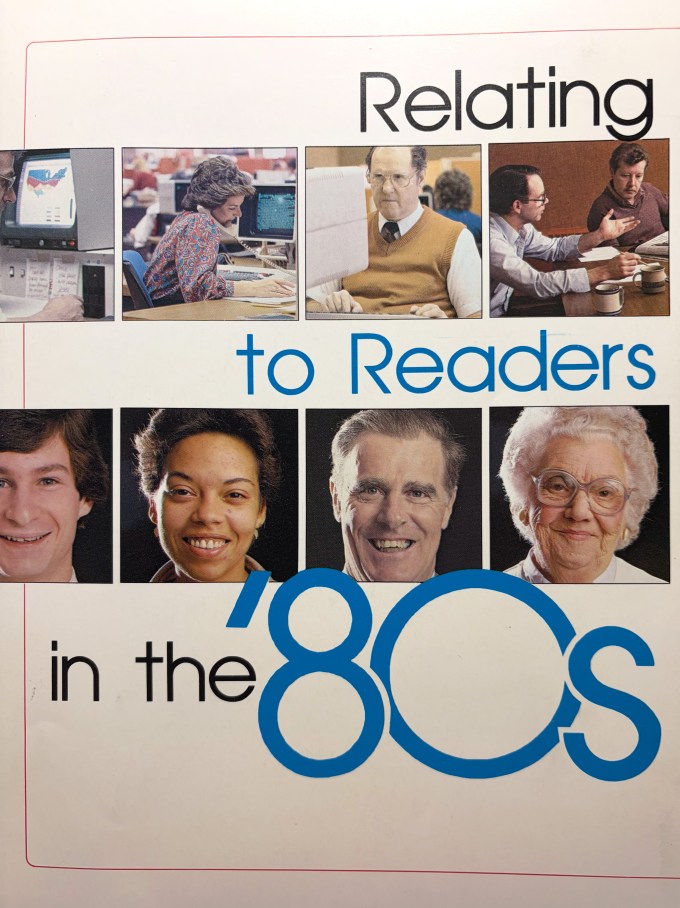
My, how things have changed in the newspaper business during my lifetime! I realized that when I found a 1984 research report, “Relating to Readers in the ‘80s,” in my files. It painted a drastically different picture of the U.S. newspaper industry from what we see today.
For most of the 21st century, I’ve read about a declining newspaper industry. For example:
The number of U.S. has fallen.
Northwestern University’s October 2025 State of Local News Report said that since 2005, the number of U.S. newspapers had dropped by 40 percent (from 8,891 to 5,419). As a result, 50 million Americans lived in counties with limited or no access to local news.
Newspaper reach has declined.
Newspaper print circulation dropped by 70 percent (from 53.35 million to 15.25 million) from 2005 to 2025, the Northwestern report said. Online page views on the 100 largest newspaper websites had gone down by 40 percent. Less than 20 percent of the remaining 937 U.S. “daily” newspapers (down from 1,566 in 2005) were printed and delivered seven days a week. Only 56 percent appeared every day.
The newspaper workforce has dwindled.
The number of journalists working in local U.S. newsrooms has fallen from 75,000 in 2005 to 30,160 in 2024, the Northwestern report said. The total newspaper workforce has gone from 365,460 in 2005 to 91,550 in 2024.
Interest in news reports has waned.
Pew Research reported in February 2026 that 48 percent of Americans considered news irrelevant to their lives. Forty-nine percent didn’t actively seek out news. They just came across it. Nevertheless, 80 percent said they had a responsibility to be informed about the news when they voted.
Trust in news reports has fallen.
Gallup reported in March 2026 that 28 percent of Americans had a “great deal” or “fair amount” of trust in news media. Another 36 percent indicated “not very much confidence” in news reporting, and 34 percent reported “none at all.” A February 2026 Pew Research survey showed a similar lack of trust in news organizations. Pew said that adults younger than 30 were less likely than other groups to trust journalists.
A 2025 News Literacy Project survey found that 84 percent of teens (ages 13 to 18) described news organizations negatively. The teens called news reporting fake, crazy, boring, biased, and sad.
Things used to be different.
None of these trends was true in the report I found in my files. “Relating to Readers in the ‘80s,” said:
Newspapers were here to stay.
Study participants recognized that screens may someday deliver news. Nevertheless, 75 percent said computer technology wouldn’t replace printed newspapers. Sixty-four percent agreed that “there is really no substitute for a newspaper every day” (p. 13).
Almost everyone was a reader.
Ninety percent of study participants had read a daily newspaper in the past week. Seventy-eight percent had read a daily newspaper three or four times in the same period. Forty-six percent said they were reading newspapers more frequently in 1984 than in 1979. Forty-one percent said they were reading newspapers at about the same frequency. Twenty-two percent said they read more than one newspaper per day.
Of course, people 18 to 24 (close to what Pew now calls Generation X) found newspapers less essential in 1984 than their elders. Young people were less likely than other age groups to read newspapers regularly (a trend that continued). A 21-year-old secretary was quoted as saying, “The paper is written for my mother, not me” (p. 41).
Following daily news was important.
Readers in 1984 felt a responsibility to keep up with the news. Seventy-seven percent agreed that “I find a greater need to keep up with things and to be better informed than I did in the past” (p. 12). But 43 percent said they were often too busy to keep up with current events. Nevertheless, 60 percent said a newspaper’s main job was to keep the public well-informed about issues of the day.
Readers supported press freedom.
Only 25 percent of people in the 1984 study agreed that “the President has a right to stop a newspaper from publishing a story he feels is biased or inaccurate” (p. 23). Eighty-six percent agreed that “If the government tried to close down a newspaper and stop it from publishing, I’d be upset enough to do something” (p. 23). Seventy-four percent agreed that “It’s important for the public to have the press present when American military forces are sent to another country” (p. 23).
My newspaper is accurate and fair.
Much like today, most people in 1984 thought newspaper reporting, in general, was unfair (57 percent) or biased (53 percent). But 84 percent described the newspapers they read as “most often accurate.” Only 39 percent said they thought the newspaper they read was biased.
The 1984 research study was commissioned by the American Society of Newspaper Editors. The 52-page report updated findings from a 1978 study called “Changing Needs of Newspaper Readers” and covered a wide range of readers’ opinions. Those opinions dealt with not only perceptions of newspapers but also story topics that interested readers, criticisms of newspaper performance (especially compared to television news), the information marketplace, and customer service.
Both reports advised editors and publishers on how newspapers might need to evolve to better serve readers and potential readers. Suggestions in 1984 included:
- Providing a complete newspaper that balances local, national, and international news.
- Emphasizing hard news with solid details.
- Beefing up coverage of business, consumerism, health care, the environment, family, and education.
- Recognizing that women were interested in sports and business, not just fashion, cooking, and home furnishings.
- Writing clearly; avoiding “newspeak.”
While many newspapers followed these suggestions, content changes clearly weren’t enough to save the newspaper business from the declines we have seen since 2005.
The 1984 report clearly didn’t envision at least 10 years of partisan attacks on newspaper credibility. Readers in the 1984 study said they found newspaper performance satisfactory in almost every area of interest: hard news, human-interest stories, sports, and entertainment coverage. Eighty-eight percent said they thought their local newspaper really cared about their community.
The 1984 report clearly didn’t foresee how technology would destroy the newspaper business model of the 20th century. Advertising, both display and classified, moved to online delivery channels. Newspaper operating revenue tanked as a result.
The 1984 report clearly didn’t recognize that news reporting would lose value in readers’ eyes. News now flows for free across the internet and through social networks. Fifty-two percent in the February 2026 Pew survey said they were “worn out” by the amount of news they now see. Only 8 percent in a related February Pew study said that individual Americans had a responsibility to pay for news. Only 16 percent of adults in the same study said they had paid for news in the past 12 months.
The “indispensable” newspaper that was such a “bargain” in 1984 (p. 13) is now irrelevant to most Americans. My, how things have changed.

